Immersive journalism can’t rely on the wow factor forever, so is empathy its key feature?

By Samuel Peckett

Immersive journalism’s wow factor is easy to understand. Being able to look around in 360-degree photos and 360-videos using your phone is impressive. So, too, is using virtual reality (VR) headsets to be taken to places you’ve never visited before, or using augmented reality (AR) to superimpose images onto the real world through your smartphone’s camera.

The wow factor with immersive technologies has been well documented, including in journalism. While this is exciting for the medium and helps bring new people to the technology, Alisdair Swenson, Research Associate at Manchester Metropolitan University’s Creative AR and VR Hub, says it likely won’t last forever.

“The risk with VR is that the first time you use it, it’s really cool, and maybe again a few times after that – there’s a real novelty. People just want to try VR. That’s going to disappear quite quickly as more people try it and get used to it. Using a VR headset itself isn’t going to be the draw, it’s going to be having a compelling experience.”

Experiencing the wow factor with VR. Photo by Hammer & Tusk on Unsplash .

Phil Birchinall, Senior Director for Immersive Content at Discovery Education, a company that utilises VR and AR in the classroom, says that you need to be careful not to rely on this wow factor.

“We’ve got to be careful with immersive technologies and treat it like a laser, pointing it exactly where you need it rather than just doing it for the sake of it. It still has a wow moment – if done right. If you’re teaching children about Mars and the planet just appears as a globe in front of them, they’ll just go: ‘So what?’

“‘So what?’ is one of our principle questions – if you’re just doing it for the sake of doing it there’s no point.”

You now need to make sure you’re creating a compelling experience, and a way to do so with immersive journalism is utilising its ability to create empathy in the story you’re telling.

The ’empathy machine’

Alisdair said: “VR allows you to put yourself in someone else’s shoes. This idea of embodiment and inhabiting a character and what that means for you psychologically leads to what we call the ‘empathy machine’. That level of empathy and embodiment is very strong in VR.”

Nonny de la Peña, regularly referred to as the ‘Godmother of Virtual Reality’ and oft credited with helping to create the genre of immersive journalism, also calls VR an ’empathy machine’ due to it’s ability to allow you to interact with people and places you wouldn’t usually be able to, helping you to understand them better.

Dr David Dunkley Gyimah, Senior Lecturer in the School of Journalism, Media and Culture at Cardiff University, explained a breakthrough moment for documentary film also utilised emotional impact.

“The breakthrough movie was a film called Primary, which was about Kennedy going for the presidency and there’s a major scene in that film when the cameraman follows Kennedy onto the stage, while every single other news crew was stuck to a tripod. You go all the way onto the stage. For the first time, you’re in the emotion.”

Primary utilised new techniques to emotionally involve the audience more than ever before.

Immersive technologies allow us to now go one step further. In this example, instead of simply joining Kennedy as he walks on stage, you could now experience these emotions by ’embodiment’, walking onto the stage as Kennedy through VR or 360-degree video.

David added: “VR builds on immersion in ways only technology can. It’s a heightened sense of the world.”

Stories told through immersive technologies stick with those who experience them longer than text-based stories, too. In an article for the Cyberpsychology, Behavior, and Social Networking journal, it was explained that consuming a story via immersive technology increases the consumer’s sense of a story’s credibility, their story recall and their story-sharing intention, as well as their feelings of empathy.

As a result, telling stories through immersive journalism can help create a more complete picture. Not only does the consumer understand what happened, they also have a better idea of how the people who experienced it felt through increased feelings of empathy. That’s a huge feature for immersive journalism as the wow factor begins to wane.

As Alisdair said: “A picture speaks a thousand words, but if we can put someone in an immersive or 360-degree environment, then how many words is that?”
Can virtual reality break into the journalism mainstream?

By Samuel Peckett

Today, virtual reality technology is far more common than it was even just five years ago. Two years after being bought by Facebook for $2 billion in 2014, the Oculus Rift VR headset hit the market, and has since received an upgrade, with the Oculus Rift S being released in 2019.

The Rift has finally allowed VR technology to be sold as a mass consumer product, but getting to this point has taken a long time.

Alisdair Swenson, Research Associate with Manchester Metropolitan University’s Creative AR & VR Hub, explained that this isn’t the first time VR has tried to make a breakthrough.

“There have been attempts to bring VR out before now in the 1980s, and things like the Sensorama back in the 1960s tried to do it by basically strapping a huge TV to your face.”

In the 1990s, technological advances were making VR more viable, but it still cost “tens of thousands of pounds”, making it infeasible as a mass product.

“What’s really happened in the last few years is that mobile technology has brought down the price of the screens and the sensors, all the things you need in order to make a VR headset work. These things have come down in cost and are now available to the general public.”

The Creative AR & VR Hub team. Alisdair can be seen middle left.

Not only is VR now more readily available to the general public, it’s also getting safer.

“You can walk in a space of 30 square metres and it takes into account safety, so if you’re about to walk into something it shows you the real view of the world, so you can see.” 

While Oculus have made it clear that the Rift is primarily a gaming tool, Alisdair believes the scene is set for VR to dive into a variety of industries, such as journalism.

“I think [Oculus Rift] got massive traction and interest from many people, mainly games players. But now it’s coming out that it’s not games but it’s experiences that can come from these immersive technologies, and that’s what I think we’re going to see more and more of.”

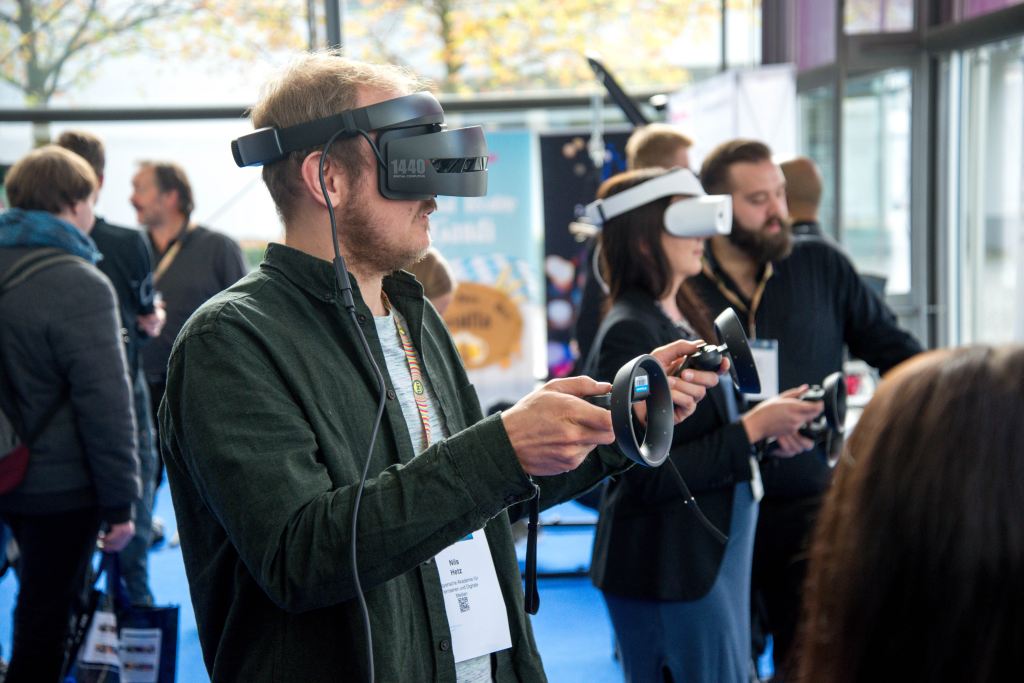
Oculus Rift uses a headset and two touch controllers to track your movement.

While the Rift began with gaming in mind, a huge selection of apps are now available, including a variety of apps based around storytelling and narrative. These apps are available for use on the Rift, alongside competitors like the HTC Vive and Open-Source Virtual Reality (OSVR).

The difficulty of creating VR content

Although Alisdair is predicting we will see more and more from these technologies, he explained that creating VR content is tough.

“There are methods of capturing, but making interactive content or 3D content where you need to make a model or 3D scan, that can be very expensive. You need the in-house expertise to pull it off in a timely fashion.”

As a result, the journalism industry, which has been perceived to be on cusp on a VR boom for years now, is still waiting for that boom to arrive. Speaking to journalism.co.uk last year, Sarah Redohl, Editor for Immersive Shooter, said: “20XX is now the year of VR, because I am not going to say that 2018 will be the year of VR – we said that with 2015, 2016 and 2017, but I think we are in the age of VR.”

A virtual reality hadset in use. Photo by stephan sorkin on Unsplash

While those in the industry remain hopeful it will take off, some reports suggest that sales of VR headsets are beginning to plateau or even decline, as Augmented Reality (AR), the idea of using technology to superimpose imagery on the real world, becomes a new focus.

While Oculus did bring VR to a mass market, the price point may have been too high for it to be widely adopted – making it hard to be used as a viable piece of technology for telling news stories on a large scale. That, coupled with the cost and time of developing virtual worlds, means that VR hasn’t yet gone mainstream in journalism – the time and cost just doesn’t reach a large enough audience.

The growth of AR

Possibly detrimental to VR’s growth into mainstream journalism is the rise of AR, which Alisdair says has “well overtaken VR” in the immersive industry, because we have the required technology, such as cameras on smartphones, “in our pockets”.

With Amazon investing in AR glasses, alongside rumours that Apple are doing the same and are possibly planning for AR glasses to replace the iPhone, it could be that AR ends up being adopted on a large scale instead of VR.

Speaking to The Independent in 2017, Apple CEO Tim Cook said: “The smartphone is for everyone, we don’t have to think the iPhone is about a certain demographic, or country or vertical market: it’s for everyone. I think AR is that big, it’s huge.”

If AR does get that big, it’s possible that VR would have to step aside for the new immersive technology of choice, before it ever gets the chance to hit the journalism mainstream.

Blurred reality – will immersive media be able to control your thoughts?

By Lewis Finney

The UK is currently in the midst an election that is considered by many to be one of the most important in living memory. With the future of the NHS, relationships with the EU, and societal issues such as homelessness and foodbanks all in the public’s focus, reliable information and trustworthy leaders should be of paramount importance to the electorate. Unfortunately, the integrity of both are questionable at best.

The integrity of politicians aside, the world we live in today can easily be infiltrated by propaganda, misinformation and disinformation. Social media platforms offer little in the way of fact checking political advertisements, often designed to intentionally mislead targeted would-be voters, so aimed at due to their perceived malleability.

Suggestions that the Brexit referendum and Donald Trump’s successful US presidential campaign both had outside influencers organising the spread of disinformation only compound this as a worrying contemporary issue, but what does the future hold in this respect?

Technology is changing the way that we consume media. As it inevitably advances in sophistication and usability, the more commonplace certain product become in our world. Take smart watches as an example – only in the last half of this decade have they become an item that we’re used to seeing on people’s wrists.

So, what’s next?

In the technology industry, many expect that the next wearable device is likely to be spectacles with augmented reality and virtual reality capabilities. It’s frequently rumoured that Apple might have some to share with the world in the near future, although the date is perpetually being put back.

VR and AR technology is readily available and the big players in the technology industry are already involved. Those in the industry perceive it to merely be a matter of time before we’re all used to seeing the glasses as commonly as we now see smart watches.

Once the technology is widely available, it’s inevitable that industries across the board will be scrambling to make use of AR and VR, and with that, the way we consume much media will likely become immersive experiences.

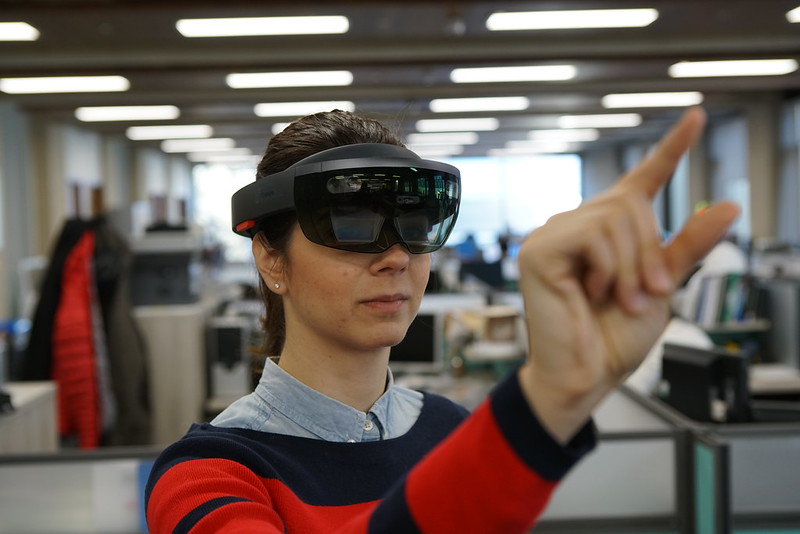
Augmented reality places information on top of our world, whereas virtual reality places us into a fabricated world.
Photo: Engineering at Cambridge (CC BY-NC-ND 2.0

Saleem Khan is a career journalist and founder of immersive and spatial technology consultancy, JOVRNALISM, based in Toronto, Canada. He sees immersive technologies as an essential part of the future of journalism and wants to open the world’s eyes to its potential.

“I look at it as an essential domain in which journalists and news organisations need to get involved because immersive and spatial media is going to be the dominant means by which we engage with information, probably within a decade,” Khan said.

Immersive technologies will not only change the way we consume media, but the way our brains engage with the material is also different

Khan said: “It’s not the same as looking at a screen, it’s not the same and reading some text, it’s a different type of interaction because a different part of your brain is active when you are immersed in an experience.

“When you’re consuming media in a more traditional sense you actually have intellectual filters that provide some distance from that, but when you’re immersed, the part of your brain that’s active is the same part of your brain that’s active as you go about your day and you experience the world. It records the things you experience as actual memories, not as information that you’re storing.”

Despite the exciting possibilities that this new way of experiencing information possesses, there also lies an alarming issue. Imagine a general election in ten years’ time, when Khan expects this technology to be readily available. If the issues surrounding misinformation and disinformation haven’t yet been addressed these unscrupulous tactics are still being used as legitimate political strategies, the potential to effectively control the minds of voters is a real possibility. If people can be swayed into voting a certain way by a targeted Facebook advert now, the potential for misuse when the information is consumed as an experience and committed to memory is far more disturbing.

“You have to be aware of the impact you’re having on the people who are consuming what you are producing.

China are the first to implement a strategy for authorisation and verification for those producing immersive content

“It is extremely difficult, maybe impossible to convince someone that something they have experienced is not real. Even though we know that immersive and spatial media are created experiences, that still doesn’t change that fact that the way that your brain responds to it is as if it’s real,” Khan said.

Politics seemed like the obvious, most topical choice to apply this to, but it could truthfully be enacted in any number of ways by those who would wish to manipulate us.

Part of Khan’s mission is to identify this potential problem and to stop it before it becomes just that: “If we’re at the point where immersive and spatial media has disinformation being produced, and the infrastructure for it doesn’t have any verification or authentication aspects to it then we have a real problem because what we’re doing then is creating a world both for virtual reality and augmented reality where the understanding of a reality in fact becomes highly malleable,” he said.

Virtual Reality is coming to change your life forever

By Lewis Finney

Not long ago, you’d be forgiven for thinking of virtual reality as being confined to science fiction or a plaything for those with large bank accounts, but these days having the required hardware at home isn’t exactly uncommon.

In 2014, Facebook bought the VR company Oculus in a deal worth $3 billion. This kickstarted a trend of the biggest, most recognisable technology companies on the planet all scrambling to get involved with the medium.

Virtual reality is no longer a distant pipedream of developers and gadget fanatics. It’s here and it’s aiming to change the way your media is produced and consumed.

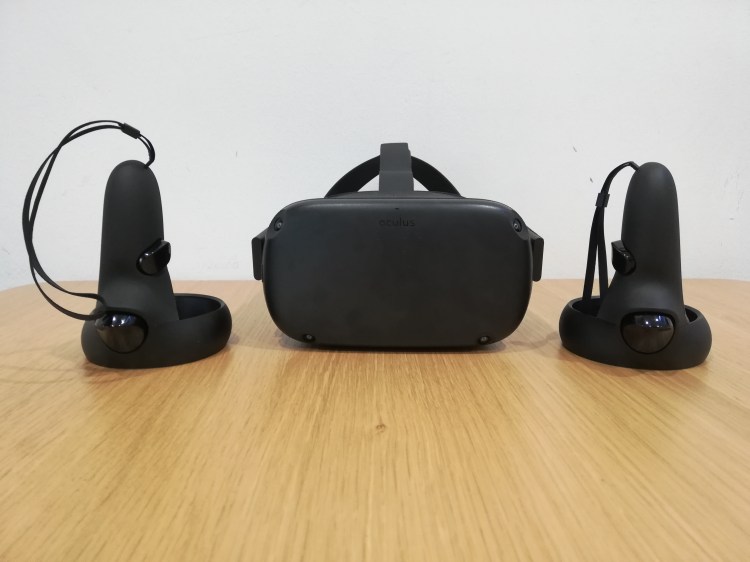
The Oculus Quest is a portable and affordable VR system.

In the early days of VR, as with any new technological phenomenon, the necessary equipment wasn’t cheap to procure but the contemporary versions are relatively inexpensive. Oculus Quest, the latest all-in-one VR headset and games console costs around £400 and a 360-degree camera can be bought for less that £100. It’s not exactly small change, but for less than £500 you could become both a producer and consumer of immersive media, and it’s only going to get cheaper.

So, is it realistic expect that VR headsets will replace the rectangle screens there we’re used to interacting with media via? And what are the pros and cons of this immersive medium?

Alasdair Swenson is a research associate at the Creative AR & VR Hub at Manchester Metropolitan University. He believes that, once the remaining kinks have been ironed out, virtual reality will become part of everyday life.

Swenson said: “The technology is improving so rapidly, it’ll become a much more natural experience. VR has been clunky for a while now – you’ve got to plug it in, you’ve got to calibrate it, you’ve got to have the right technology already or invest quite a lot financially to get that. There are also problems in public environments and using these technologies, it doesn’t necessarily work very well but it will soon.”

Advancements in other technologies might aid VR in becoming integrated into everyday life. Spatial computing is a term that’s used to describe wearable devices, such as smart watches or Fitbits, and it’s been rumoured for the last decade or so that Apple are attempting to create glasses with immersive capabilities.

Swenson believes that this rumour indicates exciting times are ahead for VR: “I think they will do both [VR and AR]. There will be clear lenses in them, and you’ll be able to see this layer of information overlaid on our view of the world, but then also it could go full VR mode as well, fully enclosing you in an experience.”

The accessibility of having a headset at home or wearing some spectacles with the potential to display VR media means that this platform could soon allow most people to experience virtual reality’s true potential.

Saleem Khan is the founder of immersive and spatial consultancy, JOVRNALISM. His company helps news organisations understand the power of VR and assists them in implement strategies to utilise the medium.

Khan also thinks exciting times are ahead: “I assume what [news organisations] are waiting for is one of the big technology players, or several of them, to come out with their more lightweight, slimmer, sleeker augmented reality or virtual reality headsets. I’m assuming that the big bet is on Apple which was originally expected to release a set of augmented reality glasses in 2020, but now the current industry discussion is that that won’t occur until maybe 2022 or 2023. But it is coming. There is virtually no doubt, no pun intended, that within a decade it’ll be a dominant form of interaction, just like the smart phone is now,” Khan said.

The main benefit that VR brings to journalism is the ability to create empathy in a much more natural and powerful way. Reading about a child’s plight in a warzone creates a certain level of empathy but if you could be transported to that warzone, walk around it and look into the eyes of that child while they speak directly to you about what they’re going through, the emotional connection would be considerably amplified.

Chris Milk is the founder of WIthin. He’s uses VR to create compelling stories

“Engaging with an audience from an emotional level I think VR has a lot to offer and I think that’s the strength of it within a journalism context.

“With VR we have the potential to embody that person or be an individual within an environment and make our own narratives or make our own deductions from being immersed in a situation,” Swenson said.

VR also could also offer the user the chance to transport to an event that they would love to be at, but otherwise would have been unable to attend.

Khan said: “If you think about what news organisations have been trying to achieve, pretty much as long as they’ve been around, they’ve been trying to bring people to scene of what’s going on so that they get a better understanding of the context to whatever the story is.

“Think about the inauguration of Barack Obama. That’s something that a lot of people wanted to be at and experience. Well, you can place someone there.”

Barack Obama addressing a huge crowd at his inauguration. If VR technologies had been advanced enough at the time it would’ve been possible to experience this as a spectator with the best possible vantage point.
(DoD photo by Senior Master Sgt. Thomas Meneguin, U.S. Air Force/Released)

Users of the most up-to-date technology are usually perceived to be young and savvy and the newest trends tend to pass by those who are put off by assuming they’re not modern enough to work them out. The beauty of VR, in this respect, is that it’s operated in a way that everyone can understand.

Swenson said: “You pick it up and use it in a natural way, it doesn’t take a lot of learning to use. You can use natural interfaces such as gesture recognition, so we can just use our hands. We all know how to use our hands, we all know how to look around and spot something, we all know how to use our ears. It’s becoming a lot more natural to consume media in that way.”

Design a site like this with WordPress.com
Get started